
By now, everyone on the planet has heard of artificial intelligence. From planning your next vacation to helping you meal prep, the applications for this new technology are constantly evolving. It seems like AI is virtually in every space we could think of. And it begs the question: How is this technology impacting the workforce? Which industries or roles are at risk of being replaced by AI? These are serious questions, right?
So, What is AI?
Before we dive in, it’s best to define it. Our friends at Pew Research Institute define it as:
“A range of applications of machine learning, computer vision and natural language processing that allow computers or machines to perform tasks autonomously. AI can substitute for or complement a variety of human tasks, such as writing, drawing, providing customer service, reading radiology scans, driving cars and more.”
(Chavda, 2023)
Sounds pretty technical, right? In English, think of it as machines not only programmed to do a task, but to also think like us. Gone are the days of the clunky sci-fi robot. As we speak, this technology continues to evolve and reach major industries and spaces.
Friend or Foe?
With all the buzz surrounding AI, it can be hard to tell whether it will be helpful or hurtful. That depends on who you’re asking. The workforce today is already being exposed to AI, so what can we learn about that? To start, certain industries and job skills are gravitating towards the use of AI. Take a look at what the Pew Research Institute found when discovering the industries most exposed to AI.
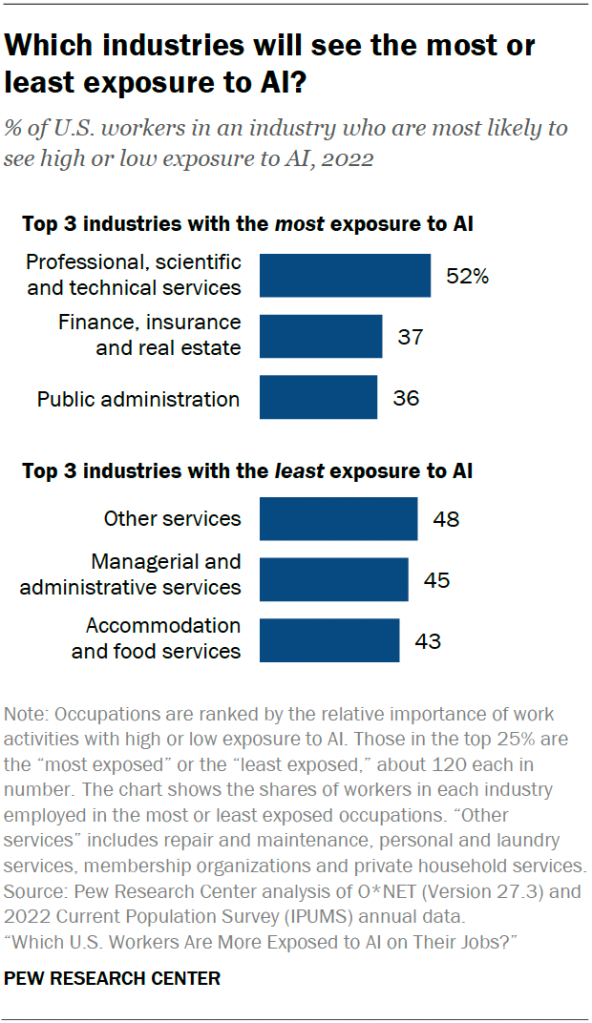
You may be wondering why those industries have more exposure. That leads to another finding that the Pew Research Institute uncovered. Fields that require a more analytical skill set, such as those needed in STEM (Science, Technology, Engineering, and Math) for data analysis and complex problem-solving, are more likely to use AI. This is because AI can report, analyze information, and make informed decisions faster. That’s just the surface of what it can do.
Other fields that are hopping on the AI train revolve around what the Pew Research Institute describes as fundamental skills like reading, writing, listening, and so forth. Sometimes, these skills fall into the realm of administrative tasks, like taking meeting notes or sending reminders—tasks that can get a bit repetitive and, let’s admit, a tad soul-sucking. But now, we have meeting platforms that take automated notes or send follow-ups, freeing up these employees to tackle more meaningful tasks. It’s like AI is lending a helping hand to professionals, not replacing them, but offering support so they can focus on what really matters.
What Jobs Are at Risk?
While AI is capable of supporting professionals to do their jobs faster and more efficiently. Are there jobs that all together AI could do better than a person?
After some research, it’s clear that certain roles are more likely to become more automated. One area revolves around administrative tasks—think of things like bookkeeping, scheduling, and data entry. There’s already software today that exists to coordinate appointments and meetings or keep track of expenses. I mean, how many of us already receive those text messages confirming appointments or birthday wishes from our dentist? I even once got a Happy Valentine’s message from my dentist—talk about overkill, lol. Anyway, you get my point.
Another area that has already implemented more automation is customer service. From making phone calls to engaging in chatbot conversations, all these automations serve as a way to provide speedy and quality service. It’s not necessarily about replacing the customer service agent but rather filtering the most pressing concerns their way. I’m honestly a fan of those chatbots when developed well because normally all I have to do is click a prompt, and I usually find my answer there instead of waiting on the phone for who knows how long?!
Now, when it comes to certain jobs, roles like telemarketing and retail assistance, such as cashiers, might be more prone to automation. Ever spotted those self-service kiosks at stores? Or maybe you’ve had those calls about your car warranty with a weird robotic voice? Yup, it’s happening.
Final Thoughts: How Should We Approach AI?
It can be a bit unsettling to think about the jobs this evolving technology might replace. And the fact that it’s always changing, evolving, and we don’t quite know its full potential. While we may not fully grasp it, I think there are some things we could consider when trying to wrap our heads around AI.
- Becoming Informed: I might not be a machine learning scientist, but I can surely do a quick Google search to learn more. I believe it’s essential to research and understand how this technology is impacting your industry and field. Learning from the experts and their perspective on this technology is key because, let’s face it, AI isn’t going away. This will help you sift through the noise and focus on what’s truly valuable to learn about AI.
- Implement What is Helpful: Once you know more about AI, you might discover some cool applications in your work to boost your success. I say, give it a shot, but just remember, this is a tool, and we shouldn’t let AI take over our ability to think critically. It’s evolving, but hey, it makes mistakes too.
- Build Your Value: Regardless of whether you find yourself in a field that’s seeing more automation or not, a great thing to do is keep on learning. In the future, there will probably be more innovations that create buzz like AI. And like technology, we want to make sure we are growing too. If there are areas you struggle with and want to improve, take classes, get a mentor, watch TikToks—every little bit helps.
Wherever you find yourself navigating the ever-changing landscape of technology, there’s always a place to start. Don’t let the headlines scare you, do your own research, and find ways to keep on learning and growing!
Want to learn more? Check out the articles I read for this blog 👇
- AI Replacing Roles
- 9-5 Jobs That Might Be Affected by AI
- What Jobs Will AI Replace?
- Which Jobs AI Might Replace
Remember, you’re not alone on this path – you’ve got a Career Buddy!
 Career Buddy Podcast